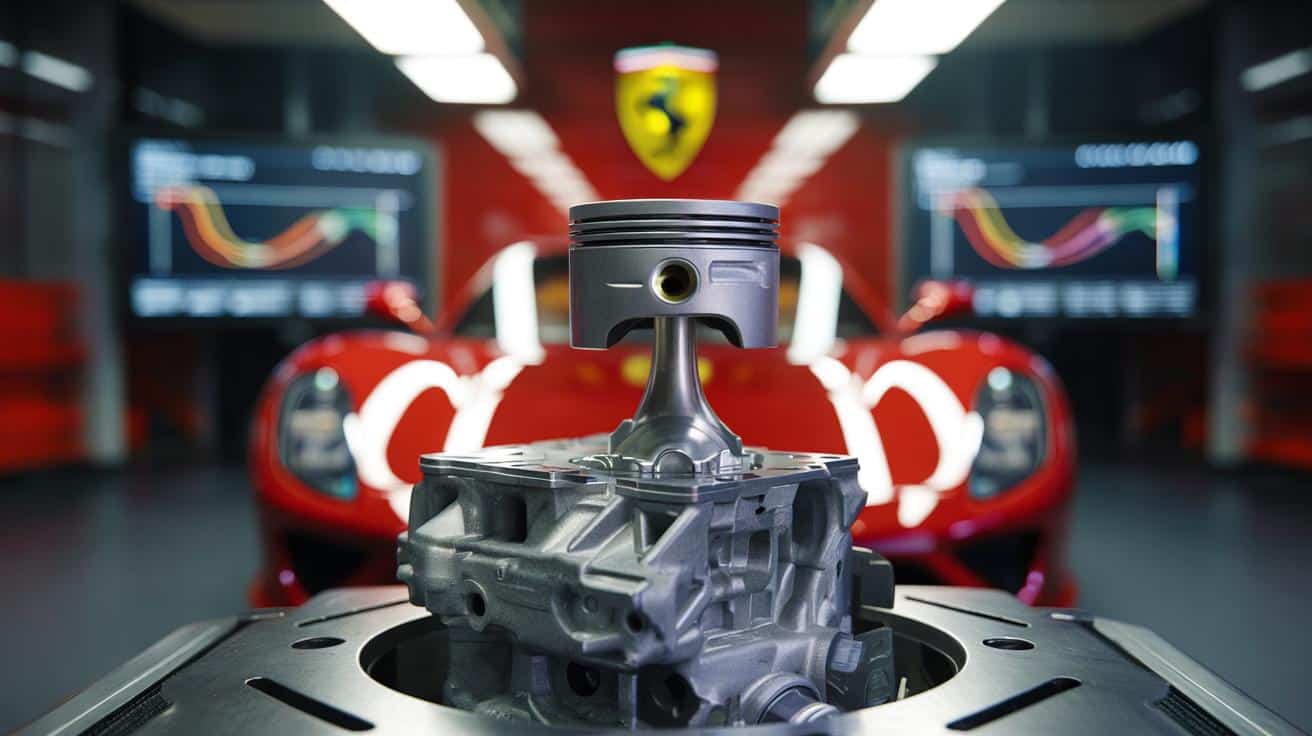
Ferrari has stunned the automotive world with the unveiling of a revolutionary oblong piston design, a departure from the classic circular piston architecture that has defined internal combustion engines for more than a century. Engineers are calling this breakthrough one of the most significant mechanical innovations of the decade, with the potential to transform engine efficiency, power delivery, and thermal behavior in ways traditional engines cannot match.
Why Ferrari’s New Piston Shape Changes Everything
Internal combustion engines have always been built around the circle. Ferrari’s oblong design challenges that foundation by reshaping the combustion chamber to increase surface area and improve burn efficiency. Engineers explain that the elongated piston maximizes the compression zone, allowing for more controlled ignition and improved torque distribution. This geometry is expected to offer a blend of high-revving performance and low-end strength that traditional shapes struggle to achieve.

How the Redesign Boosts Efficiency and Power
The oblong chamber allows for a more complete and uniform combustion process. With fewer hot spots and more consistent pressure across the piston crown, the engine can extract significantly more energy from the same amount of fuel. Ferrari’s simulations suggest improved thermal stability, faster response, and reduced friction thanks to optimized wall contact. The unique shape also changes airflow behavior inside the chamber, promoting cleaner combustion and potentially lowering emissions without sacrificing performance.
Ferrari’s Oblong Piston Concept at a Glance
| Feature | Traditional Circular Piston | Ferrari’s New Oblong Piston |
|---|---|---|
| Shape | Circular, symmetrical | Elongated oval form |
| Efficiency | Limited by chamber geometry | Expanded combustion surface |
| Heat Distribution | Hot spots common | More balanced heat flow |
| Power Delivery | Peak power in narrow band | Wider, smoother torque curve |
| Innovation Level | Mature technology | Groundbreaking redesign |
A Leap Forward in Materials and Engineering
Creating a non-circular piston capable of extreme speeds required advances in metallurgy, coating technology, and precision machining. Ferrari developed a reinforced composite alloy capable of withstanding the unique stresses generated by the unconventional shape. Specialized cylinder liners and adaptive lubrication channels were also created to support the new geometry. This engineering ecosystem allows the oblong piston to operate with the reliability and durability Ferrari demands.

Why Enthusiasts and Experts Are Calling It a Game Changer
The new piston design could influence not just supercars but the future of combustion engineering across multiple sectors. Early testing suggests engines equipped with oblong pistons deliver smoother power, stronger mid-range torque, and improved fuel efficiency—all crucial traits for performance vehicles navigating increasingly strict environmental standards. Experts believe the innovation creates a new development path for high-performance combustion engines at a time when electrification is reshaping the industry.
Could This Redefine Ferrari’s Future Engines?
While Ferrari has not confirmed which model will debut the technology, insiders suggest the design may be introduced first in limited-run performance engines before expanding to broader vehicle lines. If real-world performance matches laboratory data, the oblong piston could become a cornerstone of Ferrari’s next generation of powertrains, offering a compelling counterpoint to fully electric propulsion.

Conclusion: Ferrari’s unveiling of oblong piston technology marks a bold engineering leap that challenges more than a century of engine design. By reimagining the piston itself, engineers may have unlocked new potential in efficiency, performance, and combustion behavior. If the technology proves as transformative as early findings suggest, it could reshape not just Ferrari’s future engines but the entire landscape of high-performance automotive engineering.
Disclaimer: This article provides general information based on early engineering reports and conceptual demonstrations. Specifications, performance data, and real-world results may change as Ferrari continues development. For precise details, official announcements and technical releases from Ferrari remain the most reliable sources.


Callum notices the soft rural details, coastal elements, and unhurried moments that define many UK landscapes. His portrayals emphasize texture, quiet transitions, and modest visual impressions. He highlights how everyday places produce subtle emotional responses.