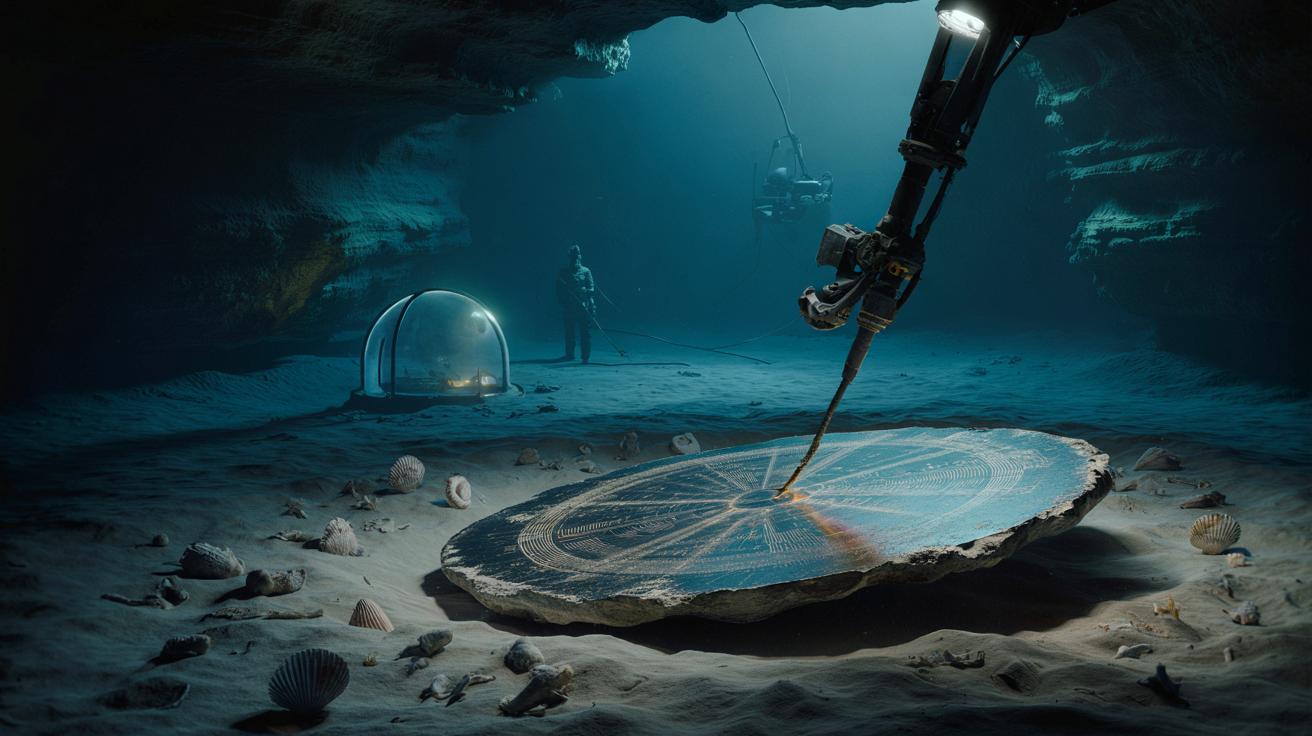
A military deep-terrain operation has revealed one of the most astonishing archaeological discoveries of the century. While conducting a high-resolution underground scan at 2,570 meters below the surface, military engineers detected structures and artifacts far older and more complex than anything expected at such depth. Archaeologists say the discovery is so unusual that it may rewrite entire chapters of human prehistory and force experts to rethink how ancient civilizations built, lived, and engineered their environments.
How the Discovery Unfolded
The military team was performing routine deep-earth scans to map structural stability for a non-archaeological project. The instruments suddenly detected symmetrical formations impossible to explain through normal geological processes. A closer analysis revealed chamber-like cavities, smooth wall surfaces, and straight angles—clear signs of human construction. Controlled drilling soon confirmed the presence of an elaborate underground complex preserved under layers of rock.

Key Details at a Glance
| Depth of Discovery | Who Detected It | Why It’s Historic |
|---|---|---|
| 2,570 meters underground | Military geotechnical survey team | Deepest man-made structures ever documented |
| Condition | Remarkably intact | Preservation reveals advanced ancient workmanship |
| Scientific Impact | Timeline-changing potential | Challenges assumptions about early engineering |
Why the Depth Changes Everything
Traditional archaeology assumes ancient structures began at the surface and were buried over time through natural processes. But 2,570 meters is far beyond what sedimentation alone could produce. Experts now believe either the structure was deliberately built underground, or an unknown geological process protected it from collapse for thousands of years. Both possibilities challenge long-standing theories of early human capability and resource use.
What Early Examinations Reveal
Initial findings suggest the structure includes carved stone walls, tool markings, and sealed passageways. Some samples appear to contain materials not commonly used in the region’s known ancient cultures. The precision of the carving hints at tools or techniques far more advanced than expected for the presumed era. If dating confirms early estimates, this site could push back the timeline of complex engineering by centuries—or more.

How Scientists Are Approaching the Investigation
A coordinated team of archaeologists, geologists, and military engineers is now taking core samples, mapping chamber layouts, and analysing micro-residues. The extreme depth has acted like a protective vault, shielding the structure from erosion, weathering, and biological decay. Researchers believe this preservation may allow unprecedented insights into construction techniques, cultural practices, and environmental conditions from long-lost civilizations.
How This Discovery Could Reshape Archaeology
The find challenges the assumption that ancient societies lacked the capability—or reason—to build deep underground. It raises new questions about early cultural behaviour, technological knowledge, and survival strategies. This discovery may lead to a re-evaluation of migration routes, trade networks, and early engineering traditions. Some experts say it could be the most significant clue yet that ancient cultures were more sophisticated, adaptable, and technologically aware than previously believed.

Conclusion: The military’s record-breaking discovery at 2,570 meters below the surface marks a turning point in archaeological science. Its depth, preservation, and engineering complexity challenge long-held ideas about early civilizations and their abilities. As analyses continue, this extraordinary site may redefine our understanding of human history and reveal knowledge lost for millennia.
Disclaimer: This article is based on general archaeological interpretations and publicly discussed early findings. Dating, cultural attribution, and scientific conclusions may change as research progresses. It is not a substitute for official archaeological reports. For the most accurate updates, follow statements from professional research institutions and archaeological teams.


Callum notices the soft rural details, coastal elements, and unhurried moments that define many UK landscapes. His portrayals emphasize texture, quiet transitions, and modest visual impressions. He highlights how everyday places produce subtle emotional responses.