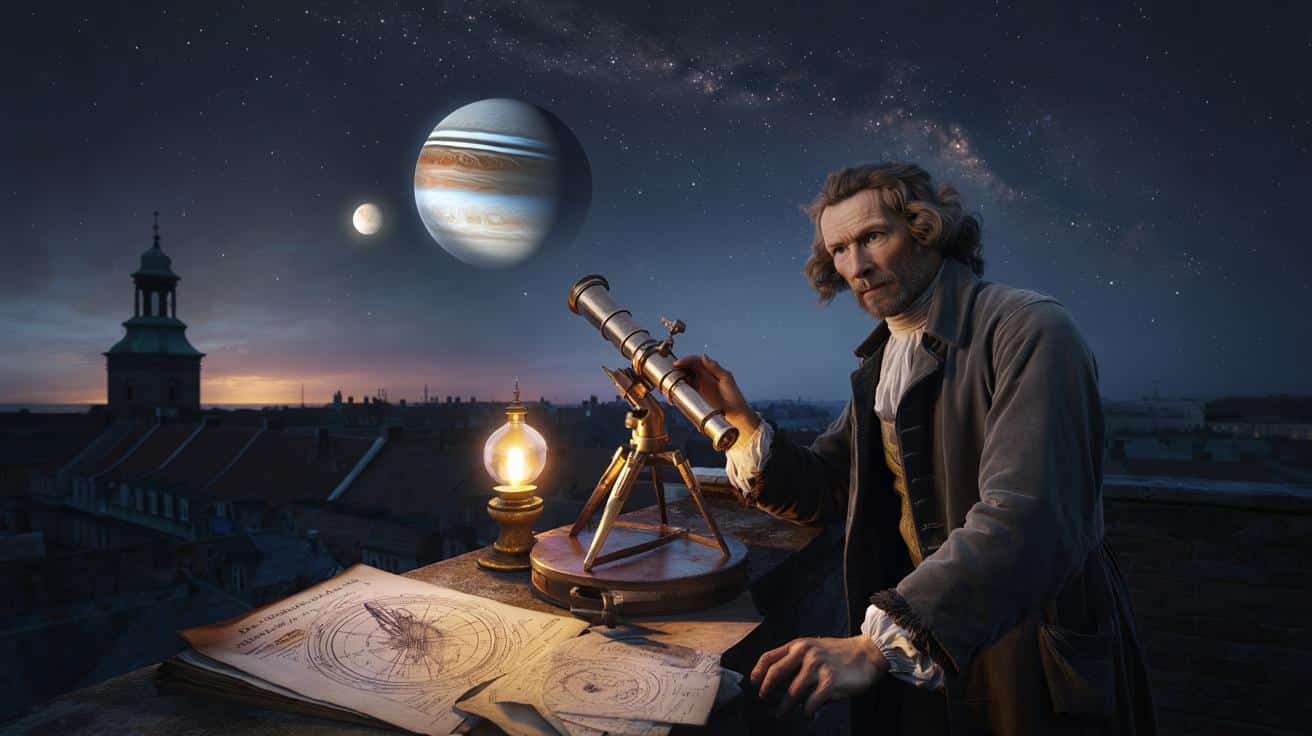
Long before Albert Einstein reshaped modern physics, a Danish astronomer named Ole Rømer made a discovery that fundamentally changed how humanity understood the universe. More than 200 years earlier, Rømer revolutionised science by proving that light does not travel instantly. Tragically, much of his groundbreaking work was later destroyed in a devastating fire, limiting his recognition for generations.
Who Was Ole Rømer
Ole Rømer was a 17th century astronomer born in Denmark, best known for being the first scientist to measure the speed of light. At a time when light was widely believed to move instantaneously, his findings challenged long held assumptions and laid the groundwork for future physics.
Rømer worked during a period when astronomy relied on careful observation rather than advanced instruments, making his achievements even more remarkable.

The Discovery That Changed Science Forever
Rømer’s breakthrough came while studying the motion of Jupiter’s moon Io. He noticed that the timing of Io’s eclipses changed depending on Earth’s position relative to Jupiter. These delays could not be explained by orbital mechanics alone.
He concluded that the variation occurred because light took time to travel across space. This was the first experimental evidence that light has a finite speed, a concept that would later become central to modern physics.
Why His Discovery Was Revolutionary
At the time, the idea that light had a measurable speed was radical. Rømer’s work shifted scientific thinking from philosophical debate to experimental proof. Although his original estimate was not perfectly accurate, it was astonishingly close given the limited tools of the era.

His insight directly influenced later scientists and eventually became a cornerstone for theories developed centuries later, including Einstein’s work on relativity.
The Tragic Loss of His Scientific Work
Much of Ole Rømer’s research was destroyed in the Copenhagen fire of 1728. The fire consumed his manuscripts, observations, and instruments, erasing a large portion of his scientific legacy. As a result, many of his contributions were known only through references made by other scientists.
This loss greatly reduced the immediate impact of his work and delayed full recognition of his influence on science.

Beyond Astronomy: Rømer’s Other Contributions
Rømer was not only an astronomer. He also made important advances in timekeeping, including improvements to calendars and the introduction of more accurate temperature scales. He contributed to public infrastructure and scientific education, showing a rare blend of theoretical insight and practical application.
His work demonstrated how observation and measurement could transform understanding across multiple fields.
Why Ole Rømer Deserves Greater Recognition
Although history often highlights later figures like Einstein, Rømer’s discovery made those future breakthroughs possible. His ability to challenge accepted beliefs using evidence marks him as one of the earliest pioneers of experimental physics.

Modern science continues to build upon the principle he established: that even seemingly constant phenomena can be measured, tested, and understood.
Conclusion:
More than two centuries before Einstein, Ole Rømer revolutionised science by proving that light travels at a finite speed. Despite the tragic loss of much of his work in a fire, his discovery reshaped astronomy and physics and laid essential foundations for modern scientific thought. His legacy stands as a reminder that transformative ideas often begin long before they are fully recognised.
Disclaimer: This article is for general informational purposes only. Historical interpretations may vary based on available records and scholarly research.


Callum notices the soft rural details, coastal elements, and unhurried moments that define many UK landscapes. His portrayals emphasize texture, quiet transitions, and modest visual impressions. He highlights how everyday places produce subtle emotional responses.